Change Maven plugin group and artifact ID
org.openrewrite.maven.ChangePluginGroupIdAndArtifactId
Change the groupId and/or the artifactId of a specified Maven plugin. Optionally update the plugin version, which may be given as an exact version or as a node-style semver selector resolved against the new plugin's available versions.
Recipe source
GitHub: ChangePluginGroupIdAndArtifactId.java, Issue Tracker, Code Genome Project
This recipe is available under the Apache License Version 2.0.
Options
| Type | Name | Description | Example |
|---|---|---|---|
String | oldGroupId | The old group ID to replace. The group ID is the first part of a plugin coordinate 'com.google.guava:guava:VERSION'. Supports glob expressions. | org.openrewrite.recipe |
String | oldArtifactId | The old artifactId to replace. The artifact ID is the second part of a plugin coordinate 'com.google.guava:guava:VERSION'. Supports glob expressions. | my-deprecated-maven-plugin |
String | newGroupId | Optional. The new group ID to use. | corp.internal.openrewrite.recipe |
String | newArtifactId | Optional. The new artifact ID to use. | my-new-maven-plugin |
String | newVersion | Optional. An exact version number or node-style semver selector used to select the version number. You can also use latest.release for the latest available version and latest.patch if the current version is a valid semantic version. For more details, you can look at the documentation page of version selectors | 29.X |
Used by
This recipe is used as part of the following composite recipes:
- Add Micronaut build plugins to 4.x
- Migrate JAXB-WS Plugin
- Update Spring Cloud Contract coordinates to Stubborn Contract
- Upgrade plugins that are incompatible with Maven 4
- Upgrade plugins to Java 25 compatible versions
- io.quarkus.updates.core.quarkus30.AdditionalChanges
Example
Parameters
| Parameter | Value |
|---|---|
| oldGroupId | io.quarkus |
| oldArtifactId | quarkus-bootstrap-maven-plugin |
| newGroupId | null |
| newArtifactId | quarkus-extension-maven-plugin |
| newVersion | null |
- pom.xml
- Diff
Before
<project>
    <modelVersion>4.0.0</modelVersion>
    <groupId>com.mycompany.app</groupId>
    <artifactId>my-app</artifactId>
    <version>1</version>
    <build>
        <plugins>
            <plugin>
                <groupId>io.quarkus</groupId>
                <artifactId>quarkus-bootstrap-maven-plugin</artifactId>
                <version>3.0.0.Beta1</version>
            </plugin>
        </plugins>
    </build>
    <profiles>
        <profile>
            <id>profile</id>
            <build>
                <plugins>
                    <plugin>
                        <groupId>io.quarkus</groupId>
                        <artifactId>quarkus-bootstrap-maven-plugin</artifactId>
                        <version>3.0.0.Beta1</version>
                    </plugin>
                </plugins>
            </build>
        </profile>
    </profiles>
</project>
After
<project>
    <modelVersion>4.0.0</modelVersion>
    <groupId>com.mycompany.app</groupId>
    <artifactId>my-app</artifactId>
    <version>1</version>
    <build>
        <plugins>
            <plugin>
                <groupId>io.quarkus</groupId>
                <artifactId>quarkus-extension-maven-plugin</artifactId>
                <version>3.0.0.Beta1</version>
            </plugin>
        </plugins>
    </build>
    <profiles>
        <profile>
            <id>profile</id>
            <build>
                <plugins>
                    <plugin>
                        <groupId>io.quarkus</groupId>
                        <artifactId>quarkus-extension-maven-plugin</artifactId>
                        <version>3.0.0.Beta1</version>
                    </plugin>
                </plugins>
            </build>
        </profile>
    </profiles>
</project>
--- pom.xml
+++ pom.xml
@@ -10,1 +10,1 @@
            <plugin>
                <groupId>io.quarkus</groupId>
-               <artifactId>quarkus-bootstrap-maven-plugin</artifactId>
+               <artifactId>quarkus-extension-maven-plugin</artifactId>
                <version>3.0.0.Beta1</version>
@@ -22,1 +22,1 @@
                    <plugin>
                        <groupId>io.quarkus</groupId>
-                       <artifactId>quarkus-bootstrap-maven-plugin</artifactId>
+                       <artifactId>quarkus-extension-maven-plugin</artifactId>
                        <version>3.0.0.Beta1</version>
Usage
This recipe has required configuration parameters. Recipes with required configuration parameters cannot be activated directly (unless you are running them via the Moderne CLI). To activate this recipe you must create a new recipe which fills in the required parameters. In your rewrite.yml create a new recipe with a unique name. For example: com.yourorg.ChangePluginGroupIdAndArtifactIdExample.
Here's how you can define and customize such a recipe within your rewrite.yml:
---
type: specs.openrewrite.org/v1beta/recipe
name: com.yourorg.ChangePluginGroupIdAndArtifactIdExample
displayName: Change Maven plugin group and artifact ID example
recipeList:
  - org.openrewrite.maven.ChangePluginGroupIdAndArtifactId:
      oldGroupId: org.openrewrite.recipe
      oldArtifactId: my-deprecated-maven-plugin
      newGroupId: corp.internal.openrewrite.recipe
      newArtifactId: my-new-maven-plugin
      newVersion: 29.X
This recipe has no required configuration parameters and comes from a rewrite core library. It can be activated directly without adding any dependencies.
Now that com.yourorg.ChangePluginGroupIdAndArtifactIdExample has been defined, activate it in your build file:
OpenRewrite artifacts, including the Maven and Gradle plugins themselves, are distributed through the Code Genome Project repository (https://artifacts.codegenomeproject.org/maven), which requires authentication. Sign in to the Code Genome Project to create a download token; your build authenticates with the email or username you signed in with, plus that token as the password. See the quickstart guide for details.
- Maven POM
- Moderne CLI
- Add the Code Genome Project credentials to your Maven
settings.xmlfile (typically at~/.m2/settings.xml), replacingUSERNAMEandTOKENwith your own:settings.xml<settings>
<servers>
<server>
<id>codegenome</id>
<username>USERNAME</username>
<password>TOKEN</password>
</server>
</servers>
</settings> - Add the following to your
pom.xmlfile:pom.xml<project>
<repositories>
<repository>
<id>codegenome</id>
<url>https://artifacts.codegenomeproject.org/maven</url>
</repository>
</repositories>
<pluginRepositories>
<pluginRepository>
<id>codegenome</id>
<url>https://artifacts.codegenomeproject.org/maven</url>
</pluginRepository>
</pluginRepositories>
<build>
<plugins>
<plugin>
<groupId>org.openrewrite.maven</groupId>
<artifactId>rewrite-maven-plugin</artifactId>
<version>6.50.0</version>
<configuration>
<exportDatatables>true</exportDatatables>
<activeRecipes>
<recipe>com.yourorg.ChangePluginGroupIdAndArtifactIdExample</recipe>
</activeRecipes>
</configuration>
</plugin>
</plugins>
</build>
</project> - Run
mvn rewrite:runto run the recipe.
You will need to have configured the Moderne CLI on your machine before you can run the following command.
mod run . --recipe ChangePluginGroupIdAndArtifactId --recipe-option "oldGroupId=org.openrewrite.recipe" --recipe-option "oldArtifactId=my-deprecated-maven-plugin"
To also set the recipe's optional settings, add them to the command. The values below are examples, not recommendations; see Options for what each one does.
mod run . --recipe ChangePluginGroupIdAndArtifactId \
  --recipe-option "oldGroupId=org.openrewrite.recipe" \
  --recipe-option "oldArtifactId=my-deprecated-maven-plugin" \
  --recipe-option "newGroupId=corp.internal.openrewrite.recipe" \
  --recipe-option "newArtifactId=my-new-maven-plugin" \
  --recipe-option "newVersion=29.X"
If the recipe is not available locally, then you can install it using:
mod config recipes jar install org.openrewrite:rewrite-maven:8.93.3
See how this recipe works across multiple open-source repositories
Run this recipe on OSS repos at scale with the Moderne SaaS.
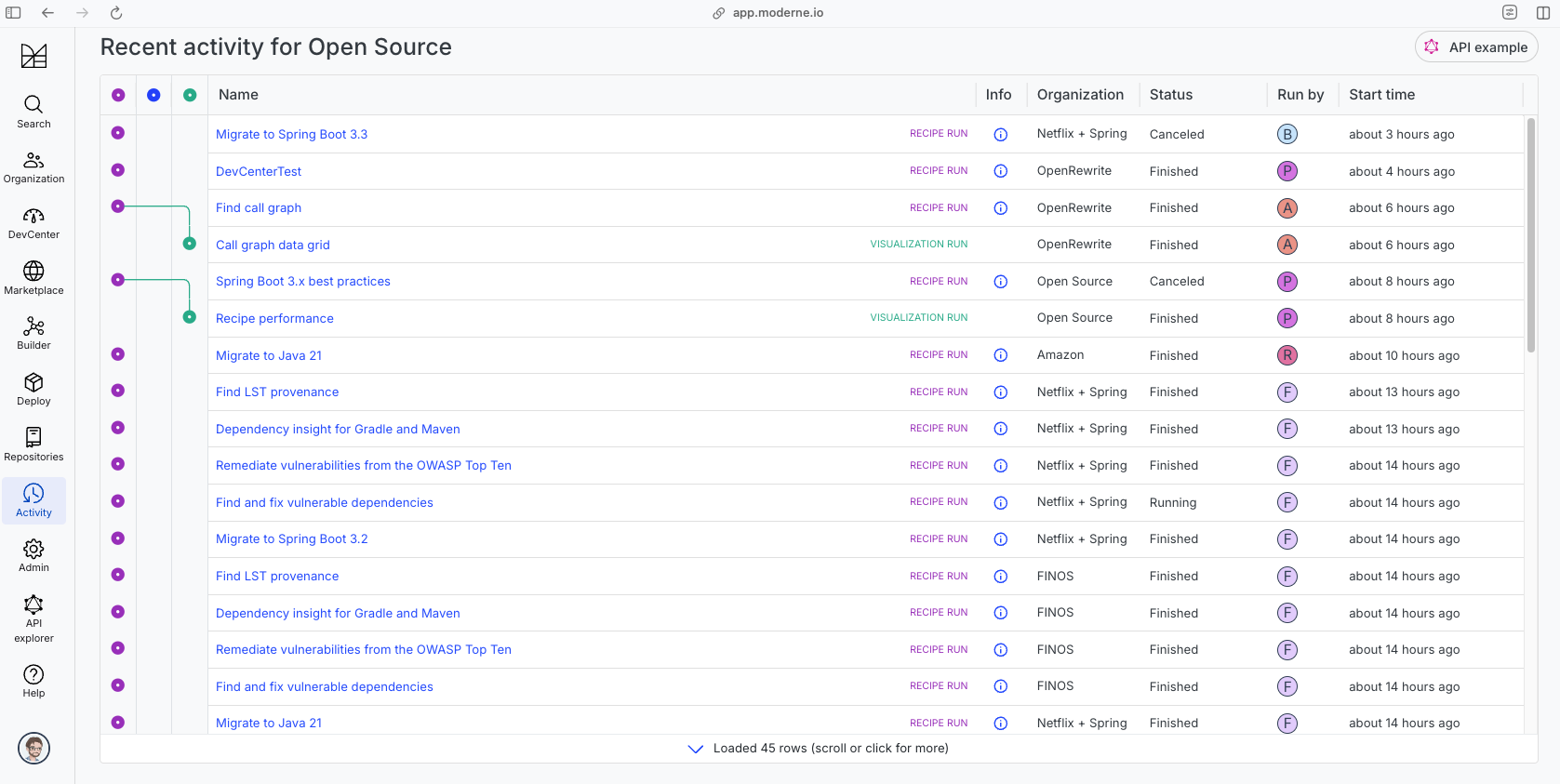
The community edition of the Moderne platform enables you to easily run recipes across thousands of open-source repositories.
Please contact Moderne for more information about safely running the recipes on your own codebase in a private SaaS.
Data Tables
- MavenMetadataFailures
- SourcesFileResults
- SearchResults
- SourcesFileErrors
- RecipeRunStats
Maven metadata failures
org.openrewrite.maven.table.MavenMetadataFailures
Attempts to resolve maven metadata that failed.
| Column Name | Description |
|---|---|
| Group id | The groupId of the artifact for which the metadata download failed. |
| Artifact id | The artifactId of the artifact for which the metadata download failed. |
| Version | The version of the artifact for which the metadata download failed. |
| Maven repository | The URL of the Maven repository that the metadata download failed on. |
| Snapshots | Does the repository support snapshots. |
| Releases | Does the repository support releases. |
| Failure | The reason the metadata download failed. |
Source files that had results
org.openrewrite.table.SourcesFileResults
Source files that were modified by the recipe run.
| Column Name | Description |
|---|---|
| Source path before the run | The source path of the file before the run. null when a source file was created during the run. |
| Source path after the run | A recipe may modify the source path. This is the path after the run. null when a source file was deleted during the run. |
| Parent of the recipe that made changes | In a hierarchical recipe, the parent of the recipe that made a change. Empty if this is the root of a hierarchy or if the recipe is not hierarchical at all. |
| Recipe that made changes | The specific recipe that made a change. |
| Estimated time saving | An estimated effort that a developer to fix manually instead of using this recipe, in unit of seconds. |
| Cycle | The recipe cycle in which the change was made. |
Source files that had search results
org.openrewrite.table.SearchResults
Search results that were found during the recipe run.
| Column Name | Description |
|---|---|
| Source path of search result before the run | The source path of the file with the search result markers present. |
| Source path of search result after run the run | A recipe may modify the source path. This is the path after the run. null when a source file was deleted during the run. |
| Result | The trimmed printed tree of the LST element that the marker is attached to. |
| Description | The content of the description of the marker. |
| Recipe that added the search marker | The specific recipe that added the Search marker. |
Source files that errored on a recipe
org.openrewrite.table.SourcesFileErrors
The details of all errors produced by a recipe run.
| Column Name | Description |
|---|---|
| Source path | The file that failed to parse. |
| Recipe that made changes | The specific recipe that made a change. |
| Stack trace | The stack trace of the failure. |
Recipe performance
org.openrewrite.table.RecipeRunStats
Statistics used in analyzing the performance of recipes.
| Column Name | Description |
|---|---|
| The recipe | The recipe whose stats are being measured both individually and cumulatively. |
| Source file count | The number of source files the recipe ran over. |
| Source file changed count | The number of source files which were changed in the recipe run. Includes files created, deleted, and edited. |
| Cumulative scanning time (ns) | The total time spent across the scanning phase of this recipe. |
| Max scanning time (ns) | The max time scanning any one source file. |
| Cumulative edit time (ns) | The total time spent across the editing phase of this recipe. |
| Max edit time (ns) | The max time editing any one source file. |