Migrate to Spring Boot 3.0 (Community Edition)
org.openrewrite.java.spring.boot3.UpgradeSpringBoot_3_0
Migrate applications to the latest Spring Boot 3.0 release. This recipe will modify an application's build files, make changes to deprecated/preferred APIs, and migrate configuration settings that have changes between versions. This recipe will also chain additional framework migrations (Spring Framework, Spring Data, etc) that are required as part of the migration to Spring Boot 2.7.
Tags
Recipe source
GitHub: spring-boot-30.yml, Issue Tracker, Code Genome Project
This recipe is composed of more than one recipe. If you want to customize the set of recipes this is composed of, you can find and copy the GitHub source for the recipe from the link above.
This recipe is available under the Moderne Source Available License. Moderne customers can download precompiled artifacts from The Code Genome Project. For non-commercial use you can build the artifact from source locally.
Definition
- Recipe List
- Yaml Recipe List
Preconditions
Recipes
- Migrate to Spring Boot 2.7
- Enable Spring Batch Annotation
- Change type
- oldFullyQualifiedTypeName:
org.hibernate.validator.internal.constraintvalidators.hv.EmailValidator - newFullyQualifiedTypeName:
org.hibernate.validator.internal.constraintvalidators.bv.EmailValidator
- oldFullyQualifiedTypeName:
- Migrate to Java 17
- Upgrade Gradle or Maven dependency versions
- groupId:
org.springframework.boot - artifactId:
* - newVersion:
3.0.x - overrideManagedVersion:
false - retainVersions:
[org.thymeleaf:thymeleaf-spring5, org.thymeleaf.extras:thymeleaf-extras-springsecurity5]
- groupId:
- Upgrade Gradle or Maven dependency versions
- groupId:
org.springframework.boot - artifactId:
spring-boot-dependencies - newVersion:
3.0.x - overrideManagedVersion:
true
- groupId:
- Upgrade Gradle or Maven dependency versions
- groupId:
org.springframework - artifactId:
* - newVersion:
6.0.x
- groupId:
- Upgrade Gradle or Maven dependency versions
- groupId:
org.springframework.ws - artifactId:
* - newVersion:
4.x
- groupId:
- Upgrade Maven plugin version
- groupId:
org.springframework.boot - artifactId:
spring-boot-maven-plugin - newVersion:
3.0.x
- groupId:
- Upgrade Maven parent project version
- groupId:
org.springframework.boot - artifactId:
spring-boot-starter-parent - newVersion:
3.0.x
- groupId:
- Update a Gradle plugin by id
- pluginIdPattern:
org.springframework.boot - newVersion:
3.0.x
- pluginIdPattern:
- Update a Gradle plugin by id
- pluginIdPattern:
io.spring.dependency-management - newVersion:
1.1.x
- pluginIdPattern:
- Update Gradle wrapper
- version:
^7.4 - addIfMissing:
false
- version:
- Migrate to Spring Framework 6.0 (Community Edition)
- Remove Unnecessary
@ConstructorBinding - Use
AutoConfiguration#imports - Remove the deprecated properties
additional-keys-to-sanitizefrom theconfigpropsandenvend points - Rename
server.max-http-header-sizetoserver.max-http-request-header-size - Downgrade Jakarta Servlet API to 5.0 when using Jetty
- Add
@Configurationto classes with@EnableXXXSecurityannotations- forceAddConfiguration:
false
- forceAddConfiguration:
- Migrate Spring Boot properties to 3.0
- Migrate thymeleaf dependencies to Spring Boot 3.x
- Migrate dropWizard dependencies to Spring Boot 3.x
- Rename
logback.xmltologback-spring.xml - Remove
SolrAutoConfiguration - Migrate
WebMvcTagsProvidertoDefaultServerRequestObservationConvention @Beanmethods may not returnvoid- Migrate to Spring Batch 5.0 from 4.3
- Migrate to Spring Security 6.0
- Migrate to Spring Cloud 2022
- Upgrade to SpringDoc 2.1
- Migrate to Hibernate 6.1.x
- Upgrade MyBatis to Spring Boot 3.0
- Migrate SAP cloud foundry logging support to Spring Boot 3.x
---
type: specs.openrewrite.org/v1beta/recipe
name: org.openrewrite.java.spring.boot3.UpgradeSpringBoot_3_0
displayName: Migrate to Spring Boot 3.0 (Community Edition)
description: |
  Migrate applications to the latest Spring Boot 3.0 release. This recipe will modify an application's build files, make changes to deprecated/preferred APIs, and migrate configuration settings that have changes between versions. This recipe will also chain additional framework migrations (Spring Framework, Spring Data, etc) that are required as part of the migration to Spring Boot 2.7.
tags:
  - spring
  - boot
preconditions:
  - org.openrewrite.Singleton
recipeList:
  - org.openrewrite.java.spring.boot2.UpgradeSpringBoot_2_7
  - org.openrewrite.java.spring.boot3.RemoveEnableBatchProcessing
  - org.openrewrite.java.ChangeType:
      oldFullyQualifiedTypeName: org.hibernate.validator.internal.constraintvalidators.hv.EmailValidator
      newFullyQualifiedTypeName: org.hibernate.validator.internal.constraintvalidators.bv.EmailValidator
  - org.openrewrite.java.migrate.UpgradeToJava17
  - org.openrewrite.java.dependencies.UpgradeDependencyVersion:
      groupId: org.springframework.boot
      artifactId: "*"
      newVersion: 3.0.x
      overrideManagedVersion: false
      retainVersions: [org.thymeleaf:thymeleaf-spring5, org.thymeleaf.extras:thymeleaf-extras-springsecurity5]
  - org.openrewrite.java.dependencies.UpgradeDependencyVersion:
      groupId: org.springframework.boot
      artifactId: spring-boot-dependencies
      newVersion: 3.0.x
      overrideManagedVersion: true
  - org.openrewrite.java.dependencies.UpgradeDependencyVersion:
      groupId: org.springframework
      artifactId: "*"
      newVersion: 6.0.x
  - org.openrewrite.java.dependencies.UpgradeDependencyVersion:
      groupId: org.springframework.ws
      artifactId: "*"
      newVersion: 4.x
  - org.openrewrite.maven.UpgradePluginVersion:
      groupId: org.springframework.boot
      artifactId: spring-boot-maven-plugin
      newVersion: 3.0.x
  - org.openrewrite.maven.UpgradeParentVersion:
      groupId: org.springframework.boot
      artifactId: spring-boot-starter-parent
      newVersion: 3.0.x
  - org.openrewrite.gradle.plugins.UpgradePluginVersion:
      pluginIdPattern: org.springframework.boot
      newVersion: 3.0.x
  - org.openrewrite.gradle.plugins.UpgradePluginVersion:
      pluginIdPattern: io.spring.dependency-management
      newVersion: 1.1.x
  - org.openrewrite.gradle.UpdateGradleWrapper:
      version: ^7.4
      addIfMissing: false
  - org.openrewrite.java.spring.framework.UpgradeSpringFramework_6_0
  - org.openrewrite.java.spring.boot3.RemoveConstructorBindingAnnotation
  - org.openrewrite.java.spring.boot2.MoveAutoConfigurationToImportsFile
  - org.openrewrite.java.spring.boot3.ActuatorEndpointSanitization
  - org.openrewrite.java.spring.boot3.MigrateMaxHttpHeaderSize
  - org.openrewrite.java.spring.boot3.DowngradeServletApiWhenUsingJetty
  - org.openrewrite.java.spring.boot3.ConfigurationOverEnableSecurity:
      forceAddConfiguration: false
  - org.openrewrite.java.spring.boot3.SpringBootProperties_3_0
  - org.openrewrite.java.spring.boot3.MigrateThymeleafDependencies
  - org.openrewrite.java.spring.boot3.MigrateDropWizardDependencies
  - org.openrewrite.java.spring.boot3.RenameLogbackToLogbackSpring
  - org.openrewrite.java.spring.boot3.RemoveSolrAutoConfigurationExclude
  - org.openrewrite.java.spring.boot3.MigrateWebMvcTagsToObservationConvention
  - org.openrewrite.java.spring.framework.BeanMethodReturnNull
  - org.openrewrite.java.spring.batch.SpringBatch4To5Migration
  - org.openrewrite.java.spring.security6.UpgradeSpringSecurity_6_0
  - org.openrewrite.java.spring.cloud2022.UpgradeSpringCloud_2022
  - org.openrewrite.java.springdoc.UpgradeSpringDoc_2
  - org.openrewrite.hibernate.MigrateToHibernate61
  - org.openrewrite.java.spring.boot3.UpgradeMyBatisToSpringBoot_3_0
  - org.openrewrite.java.spring.boot3.MigrateSapCfJavaLoggingSupport
Used by
This recipe is used as part of the following composite recipes:
Examples
Example 1
Boot3UpgradeTest#xmlBindMissing
- java
- Diff
Before
package org.springframework.samples.petclinic.vet;

import java.io.Serializable;

import javax.persistence.Column;
import javax.persistence.Entity;
import javax.persistence.GeneratedValue;
import javax.persistence.GenerationType;
import javax.persistence.Id;
import javax.persistence.Table;

@Entity
@Table(name = "specialties")
public class Specialty implements Serializable {

    @Id
    @GeneratedValue(strategy = GenerationType.IDENTITY)
    private Integer id;

    @Column(name = "name")
    private String name;

    public Integer getId() {
        return id;
    }

    public void setId(Integer id) {
        this.id = id;
    }

    public boolean isNew() {
        return this.id == null;
    }


    public String getName() {
        return this.name;
    }

    public void setName(String name) {
        this.name = name;
    }


}
After
package org.springframework.samples.petclinic.vet;

import java.io.Serializable;

import jakarta.persistence.Column;
import jakarta.persistence.Entity;
import jakarta.persistence.GeneratedValue;
import jakarta.persistence.GenerationType;
import jakarta.persistence.Id;
import jakarta.persistence.Table;

@Entity
@Table(name = "specialties")
public class Specialty implements Serializable {

    @Id
    @GeneratedValue(strategy = GenerationType.IDENTITY)
    private Integer id;

    @Column(name = "name")
    private String name;

    public Integer getId() {
        return id;
    }

    public void setId(Integer id) {
        this.id = id;
    }

    public boolean isNew() {
        return this.id == null;
    }


    public String getName() {
        return this.name;
    }

    public void setName(String name) {
        this.name = name;
    }


}
@@ -5,6 +5,6 @@
import java.io.Serializable;

-import javax.persistence.Column;
-import javax.persistence.Entity;
-import javax.persistence.GeneratedValue;
-import javax.persistence.GenerationType;
-import javax.persistence.Id;
-import javax.persistence.Table;
+import jakarta.persistence.Column;
+import jakarta.persistence.Entity;
+import jakarta.persistence.GeneratedValue;
+import jakarta.persistence.GenerationType;
+import jakarta.persistence.Id;
+import jakarta.persistence.Table;
- java
- Diff
Before
package org.springframework.samples.petclinic.vet;

import java.io.Serializable;
import java.util.ArrayList;
import java.util.Collections;
import java.util.HashSet;
import java.util.List;
import java.util.Set;

import javax.persistence.Column;
import javax.persistence.Entity;
import javax.persistence.FetchType;
import javax.persistence.GeneratedValue;
import javax.persistence.GenerationType;
import javax.persistence.Id;
import javax.persistence.JoinColumn;
import javax.persistence.JoinTable;
import javax.persistence.ManyToMany;
import javax.persistence.Table;
import javax.validation.constraints.NotEmpty;
import javax.xml.bind.annotation.XmlElement;

@Entity
@Table(name = "vets")
public class Vet implements Serializable {

    @Id
    @GeneratedValue(strategy = GenerationType.IDENTITY)
    private Integer id;

    @Column(name = "name")
    private String name;

    @Column(name = "first_name")
    @NotEmpty
    private String firstName;

    @Column(name = "last_name")
    @NotEmpty
    private String lastName;

    @ManyToMany(fetch = FetchType.EAGER)
    @JoinTable(name = "vet_specialties", joinColumns = @JoinColumn(name = "vet_id"),
            inverseJoinColumns = @JoinColumn(name = "specialty_id"))
    private Set<Specialty> specialties;

    public Integer getId() {
        return id;
    }

    public void setId(Integer id) {
        this.id = id;
    }

    public boolean isNew() {
        return this.id == null;
    }

    public String getName() {
        return this.name;
    }

    public void setName(String name) {
        this.name = name;
    }

    protected Set<Specialty> getSpecialtiesInternal() {
        if (this.specialties == null) {
            this.specialties = new HashSet<>();
        }
        return this.specialties;
    }

    protected void setSpecialtiesInternal(Set<Specialty> specialties) {
        this.specialties = specialties;
    }

    @XmlElement
    public List<Specialty> getSpecialties() {
        List<Specialty> sortedSpecs = new ArrayList<>(getSpecialtiesInternal());
        return Collections.unmodifiableList(sortedSpecs);
    }

    public int getNrOfSpecialties() {
        return getSpecialtiesInternal().size();
    }

    public void addSpecialty(Specialty specialty) {
        getSpecialtiesInternal().add(specialty);
    }

    public String getFirstName() {
        return this.firstName;
    }

    public void setFirstName(String firstName) {
        this.firstName = firstName;
    }

    public String getLastName() {
        return this.lastName;
    }

    public void setLastName(String lastName) {
        this.lastName = lastName;
    }
}
After
package org.springframework.samples.petclinic.vet;

import java.io.Serializable;
import java.util.ArrayList;
import java.util.Collections;
import java.util.HashSet;
import java.util.List;
import java.util.Set;

import jakarta.persistence.Column;
import jakarta.persistence.Entity;
import jakarta.persistence.FetchType;
import jakarta.persistence.GeneratedValue;
import jakarta.persistence.GenerationType;
import jakarta.persistence.Id;
import jakarta.persistence.JoinColumn;
import jakarta.persistence.JoinTable;
import jakarta.persistence.ManyToMany;
import jakarta.persistence.Table;
import jakarta.validation.constraints.NotEmpty;
import jakarta.xml.bind.annotation.XmlElement;

@Entity
@Table(name = "vets")
public class Vet implements Serializable {

    @Id
    @GeneratedValue(strategy = GenerationType.IDENTITY)
    private Integer id;

    @Column(name = "name")
    private String name;

    @Column(name = "first_name")
    @NotEmpty
    private String firstName;

    @Column(name = "last_name")
    @NotEmpty
    private String lastName;

    @ManyToMany(fetch = FetchType.EAGER)
    @JoinTable(name = "vet_specialties", joinColumns = @JoinColumn(name = "vet_id"),
            inverseJoinColumns = @JoinColumn(name = "specialty_id"))
    private Set<Specialty> specialties;

    public Integer getId() {
        return id;
    }

    public void setId(Integer id) {
        this.id = id;
    }

    public boolean isNew() {
        return this.id == null;
    }

    public String getName() {
        return this.name;
    }

    public void setName(String name) {
        this.name = name;
    }

    protected Set<Specialty> getSpecialtiesInternal() {
        if (this.specialties == null) {
            this.specialties = new HashSet<>();
        }
        return this.specialties;
    }

    protected void setSpecialtiesInternal(Set<Specialty> specialties) {
        this.specialties = specialties;
    }

    @XmlElement
    public List<Specialty> getSpecialties() {
        List<Specialty> sortedSpecs = new ArrayList<>(getSpecialtiesInternal());
        return Collections.unmodifiableList(sortedSpecs);
    }

    public int getNrOfSpecialties() {
        return getSpecialtiesInternal().size();
    }

    public void addSpecialty(Specialty specialty) {
        getSpecialtiesInternal().add(specialty);
    }

    public String getFirstName() {
        return this.firstName;
    }

    public void setFirstName(String firstName) {
        this.firstName = firstName;
    }

    public String getLastName() {
        return this.lastName;
    }

    public void setLastName(String lastName) {
        this.lastName = lastName;
    }
}
@@ -10,12 +10,12 @@
import java.util.Set;

-import javax.persistence.Column;
-import javax.persistence.Entity;
-import javax.persistence.FetchType;
-import javax.persistence.GeneratedValue;
-import javax.persistence.GenerationType;
-import javax.persistence.Id;
-import javax.persistence.JoinColumn;
-import javax.persistence.JoinTable;
-import javax.persistence.ManyToMany;
-import javax.persistence.Table;
-import javax.validation.constraints.NotEmpty;
-import javax.xml.bind.annotation.XmlElement;
+import jakarta.persistence.Column;
+import jakarta.persistence.Entity;
+import jakarta.persistence.FetchType;
+import jakarta.persistence.GeneratedValue;
+import jakarta.persistence.GenerationType;
+import jakarta.persistence.Id;
+import jakarta.persistence.JoinColumn;
+import jakarta.persistence.JoinTable;
+import jakarta.persistence.ManyToMany;
+import jakarta.persistence.Table;
+import jakarta.validation.constraints.NotEmpty;
+import jakarta.xml.bind.annotation.XmlElement;
Unchanged
project
- pom.xml
- Diff
Before
<project>
  <modelVersion>4.0.0</modelVersion>
  <groupId>org.springframework.samples</groupId>
  <artifactId>spring-petclinic</artifactId>
  <version>2.7.3</version>

  <parent>
    <groupId>org.springframework.boot</groupId>
    <artifactId>spring-boot-starter-parent</artifactId>
    <version>2.7.3</version>
  </parent>
  <name>petclinic</name>

  <properties>
    <java.version>1.8</java.version>
  </properties>

  <dependencies>
    <dependency>
      <groupId>org.springframework.boot</groupId>
      <artifactId>spring-boot-starter-data-jpa</artifactId>
    </dependency>
    <dependency>
      <groupId>org.springframework.boot</groupId>
      <artifactId>spring-boot-starter-validation</artifactId>
    </dependency>
    <dependency>
      <groupId>org.ehcache</groupId>
      <artifactId>ehcache</artifactId>
    </dependency>
  </dependencies>
</project>
After
<project>
  <modelVersion>4.0.0</modelVersion>
  <groupId>org.springframework.samples</groupId>
  <artifactId>spring-petclinic</artifactId>
  <version>2.7.3</version>

  <parent>
    <groupId>org.springframework.boot</groupId>
    <artifactId>spring-boot-starter-parent</artifactId>
    <version>3.0.13</version>
  </parent>
  <name>petclinic</name>

  <properties>
    <java.version>17</java.version>
  </properties>

  <dependencies>
    <dependency>
      <groupId>jakarta.xml.bind</groupId>
      <artifactId>jakarta.xml.bind-api</artifactId>
    </dependency>
    <dependency>
      <groupId>org.springframework.boot</groupId>
      <artifactId>spring-boot-starter-data-jpa</artifactId>
    </dependency>
    <dependency>
      <groupId>org.springframework.boot</groupId>
      <artifactId>spring-boot-starter-validation</artifactId>
    </dependency>
    <dependency>
      <groupId>org.ehcache</groupId>
      <artifactId>ehcache</artifactId>
      <classifier>jakarta</classifier>
    </dependency>
  </dependencies>
</project>
--- pom.xml
+++ pom.xml
@@ -10,1 +10,1 @@
    <groupId>org.springframework.boot</groupId>
    <artifactId>spring-boot-starter-parent</artifactId>
-   <version>2.7.3</version>
+   <version>3.0.13</version>
  </parent>
@@ -15,1 +15,1 @@

  <properties>
-   <java.version>1.8</java.version>
+   <java.version>17</java.version>
  </properties>
@@ -20,0 +20,4 @@
  <dependencies>
    <dependency>
+     <groupId>jakarta.xml.bind</groupId>
+     <artifactId>jakarta.xml.bind-api</artifactId>
+   </dependency>
+   <dependency>
      <groupId>org.springframework.boot</groupId>
@@ -30,0 +34,1 @@
      <groupId>org.ehcache</groupId>
      <artifactId>ehcache</artifactId>
+     <classifier>jakarta</classifier>
    </dependency>
Example 2
Boot3UpgradeTest#xmlBindMissing
- java
- Diff
Before
package org.springframework.samples.petclinic.vet;

import java.io.Serializable;

import javax.persistence.Column;
import javax.persistence.Entity;
import javax.persistence.GeneratedValue;
import javax.persistence.GenerationType;
import javax.persistence.Id;
import javax.persistence.Table;

@Entity
@Table(name = "specialties")
public class Specialty implements Serializable {

    @Id
    @GeneratedValue(strategy = GenerationType.IDENTITY)
    private Integer id;

    @Column(name = "name")
    private String name;

    public Integer getId() {
        return id;
    }

    public void setId(Integer id) {
        this.id = id;
    }

    public boolean isNew() {
        return this.id == null;
    }


    public String getName() {
        return this.name;
    }

    public void setName(String name) {
        this.name = name;
    }


}
After
package org.springframework.samples.petclinic.vet;

import java.io.Serializable;

import jakarta.persistence.Column;
import jakarta.persistence.Entity;
import jakarta.persistence.GeneratedValue;
import jakarta.persistence.GenerationType;
import jakarta.persistence.Id;
import jakarta.persistence.Table;

@Entity
@Table(name = "specialties")
public class Specialty implements Serializable {

    @Id
    @GeneratedValue(strategy = GenerationType.IDENTITY)
    private Integer id;

    @Column(name = "name")
    private String name;

    public Integer getId() {
        return id;
    }

    public void setId(Integer id) {
        this.id = id;
    }

    public boolean isNew() {
        return this.id == null;
    }


    public String getName() {
        return this.name;
    }

    public void setName(String name) {
        this.name = name;
    }


}
@@ -5,6 +5,6 @@
import java.io.Serializable;

-import javax.persistence.Column;
-import javax.persistence.Entity;
-import javax.persistence.GeneratedValue;
-import javax.persistence.GenerationType;
-import javax.persistence.Id;
-import javax.persistence.Table;
+import jakarta.persistence.Column;
+import jakarta.persistence.Entity;
+import jakarta.persistence.GeneratedValue;
+import jakarta.persistence.GenerationType;
+import jakarta.persistence.Id;
+import jakarta.persistence.Table;
- java
- Diff
Before
package org.springframework.samples.petclinic.vet;

import java.io.Serializable;
import java.util.ArrayList;
import java.util.Collections;
import java.util.HashSet;
import java.util.List;
import java.util.Set;

import javax.persistence.Column;
import javax.persistence.Entity;
import javax.persistence.FetchType;
import javax.persistence.GeneratedValue;
import javax.persistence.GenerationType;
import javax.persistence.Id;
import javax.persistence.JoinColumn;
import javax.persistence.JoinTable;
import javax.persistence.ManyToMany;
import javax.persistence.Table;
import javax.validation.constraints.NotEmpty;
import javax.xml.bind.annotation.XmlElement;

@Entity
@Table(name = "vets")
public class Vet implements Serializable {

    @Id
    @GeneratedValue(strategy = GenerationType.IDENTITY)
    private Integer id;

    @Column(name = "name")
    private String name;

    @Column(name = "first_name")
    @NotEmpty
    private String firstName;

    @Column(name = "last_name")
    @NotEmpty
    private String lastName;

    @ManyToMany(fetch = FetchType.EAGER)
    @JoinTable(name = "vet_specialties", joinColumns = @JoinColumn(name = "vet_id"),
            inverseJoinColumns = @JoinColumn(name = "specialty_id"))
    private Set<Specialty> specialties;

    public Integer getId() {
        return id;
    }

    public void setId(Integer id) {
        this.id = id;
    }

    public boolean isNew() {
        return this.id == null;
    }

    public String getName() {
        return this.name;
    }

    public void setName(String name) {
        this.name = name;
    }

    protected Set<Specialty> getSpecialtiesInternal() {
        if (this.specialties == null) {
            this.specialties = new HashSet<>();
        }
        return this.specialties;
    }

    protected void setSpecialtiesInternal(Set<Specialty> specialties) {
        this.specialties = specialties;
    }

    @XmlElement
    public List<Specialty> getSpecialties() {
        List<Specialty> sortedSpecs = new ArrayList<>(getSpecialtiesInternal());
        return Collections.unmodifiableList(sortedSpecs);
    }

    public int getNrOfSpecialties() {
        return getSpecialtiesInternal().size();
    }

    public void addSpecialty(Specialty specialty) {
        getSpecialtiesInternal().add(specialty);
    }

    public String getFirstName() {
        return this.firstName;
    }

    public void setFirstName(String firstName) {
        this.firstName = firstName;
    }

    public String getLastName() {
        return this.lastName;
    }

    public void setLastName(String lastName) {
        this.lastName = lastName;
    }
}
After
package org.springframework.samples.petclinic.vet;

import java.io.Serializable;
import java.util.ArrayList;
import java.util.Collections;
import java.util.HashSet;
import java.util.List;
import java.util.Set;

import jakarta.persistence.Column;
import jakarta.persistence.Entity;
import jakarta.persistence.FetchType;
import jakarta.persistence.GeneratedValue;
import jakarta.persistence.GenerationType;
import jakarta.persistence.Id;
import jakarta.persistence.JoinColumn;
import jakarta.persistence.JoinTable;
import jakarta.persistence.ManyToMany;
import jakarta.persistence.Table;
import jakarta.validation.constraints.NotEmpty;
import jakarta.xml.bind.annotation.XmlElement;

@Entity
@Table(name = "vets")
public class Vet implements Serializable {

    @Id
    @GeneratedValue(strategy = GenerationType.IDENTITY)
    private Integer id;

    @Column(name = "name")
    private String name;

    @Column(name = "first_name")
    @NotEmpty
    private String firstName;

    @Column(name = "last_name")
    @NotEmpty
    private String lastName;

    @ManyToMany(fetch = FetchType.EAGER)
    @JoinTable(name = "vet_specialties", joinColumns = @JoinColumn(name = "vet_id"),
            inverseJoinColumns = @JoinColumn(name = "specialty_id"))
    private Set<Specialty> specialties;

    public Integer getId() {
        return id;
    }

    public void setId(Integer id) {
        this.id = id;
    }

    public boolean isNew() {
        return this.id == null;
    }

    public String getName() {
        return this.name;
    }

    public void setName(String name) {
        this.name = name;
    }

    protected Set<Specialty> getSpecialtiesInternal() {
        if (this.specialties == null) {
            this.specialties = new HashSet<>();
        }
        return this.specialties;
    }

    protected void setSpecialtiesInternal(Set<Specialty> specialties) {
        this.specialties = specialties;
    }

    @XmlElement
    public List<Specialty> getSpecialties() {
        List<Specialty> sortedSpecs = new ArrayList<>(getSpecialtiesInternal());
        return Collections.unmodifiableList(sortedSpecs);
    }

    public int getNrOfSpecialties() {
        return getSpecialtiesInternal().size();
    }

    public void addSpecialty(Specialty specialty) {
        getSpecialtiesInternal().add(specialty);
    }

    public String getFirstName() {
        return this.firstName;
    }

    public void setFirstName(String firstName) {
        this.firstName = firstName;
    }

    public String getLastName() {
        return this.lastName;
    }

    public void setLastName(String lastName) {
        this.lastName = lastName;
    }
}
@@ -10,12 +10,12 @@
import java.util.Set;

-import javax.persistence.Column;
-import javax.persistence.Entity;
-import javax.persistence.FetchType;
-import javax.persistence.GeneratedValue;
-import javax.persistence.GenerationType;
-import javax.persistence.Id;
-import javax.persistence.JoinColumn;
-import javax.persistence.JoinTable;
-import javax.persistence.ManyToMany;
-import javax.persistence.Table;
-import javax.validation.constraints.NotEmpty;
-import javax.xml.bind.annotation.XmlElement;
+import jakarta.persistence.Column;
+import jakarta.persistence.Entity;
+import jakarta.persistence.FetchType;
+import jakarta.persistence.GeneratedValue;
+import jakarta.persistence.GenerationType;
+import jakarta.persistence.Id;
+import jakarta.persistence.JoinColumn;
+import jakarta.persistence.JoinTable;
+import jakarta.persistence.ManyToMany;
+import jakarta.persistence.Table;
+import jakarta.validation.constraints.NotEmpty;
+import jakarta.xml.bind.annotation.XmlElement;
Unchanged
project
- pom.xml
- Diff
Before
<project>
  <modelVersion>4.0.0</modelVersion>
  <groupId>org.springframework.samples</groupId>
  <artifactId>spring-petclinic</artifactId>
  <version>2.7.3</version>

  <parent>
    <groupId>org.springframework.boot</groupId>
    <artifactId>spring-boot-starter-parent</artifactId>
    <version>2.7.3</version>
  </parent>
  <name>petclinic</name>

  <properties>
    <java.version>1.8</java.version>
  </properties>

  <dependencies>
    <dependency>
      <groupId>org.springframework.boot</groupId>
      <artifactId>spring-boot-starter-data-jpa</artifactId>
    </dependency>
    <dependency>
      <groupId>org.springframework.boot</groupId>
      <artifactId>spring-boot-starter-validation</artifactId>
    </dependency>
    <dependency>
      <groupId>org.ehcache</groupId>
      <artifactId>ehcache</artifactId>
    </dependency>
  </dependencies>
</project>
After
<project>
  <modelVersion>4.0.0</modelVersion>
  <groupId>org.springframework.samples</groupId>
  <artifactId>spring-petclinic</artifactId>
  <version>2.7.3</version>

  <parent>
    <groupId>org.springframework.boot</groupId>
    <artifactId>spring-boot-starter-parent</artifactId>
    <version>3.0.13</version>
  </parent>
  <name>petclinic</name>

  <properties>
    <java.version>17</java.version>
  </properties>

  <dependencies>
    <dependency>
      <groupId>jakarta.xml.bind</groupId>
      <artifactId>jakarta.xml.bind-api</artifactId>
    </dependency>
    <dependency>
      <groupId>org.springframework.boot</groupId>
      <artifactId>spring-boot-starter-data-jpa</artifactId>
    </dependency>
    <dependency>
      <groupId>org.springframework.boot</groupId>
      <artifactId>spring-boot-starter-validation</artifactId>
    </dependency>
    <dependency>
      <groupId>org.ehcache</groupId>
      <artifactId>ehcache</artifactId>
      <classifier>jakarta</classifier>
    </dependency>
  </dependencies>
</project>
--- pom.xml
+++ pom.xml
@@ -10,1 +10,1 @@
    <groupId>org.springframework.boot</groupId>
    <artifactId>spring-boot-starter-parent</artifactId>
-   <version>2.7.3</version>
+   <version>3.0.13</version>
  </parent>
@@ -15,1 +15,1 @@

  <properties>
-   <java.version>1.8</java.version>
+   <java.version>17</java.version>
  </properties>
@@ -20,0 +20,4 @@
  <dependencies>
    <dependency>
+     <groupId>jakarta.xml.bind</groupId>
+     <artifactId>jakarta.xml.bind-api</artifactId>
+   </dependency>
+   <dependency>
      <groupId>org.springframework.boot</groupId>
@@ -30,0 +34,1 @@
      <groupId>org.ehcache</groupId>
      <artifactId>ehcache</artifactId>
+     <classifier>jakarta</classifier>
    </dependency>
Usage
This recipe has no required configuration options. It can be activated by adding a dependency on `org.openrewrite.recipe:rewrite-spring` in your build file or by running a shell command (in which case no build changes are needed):
OpenRewrite artifacts, including the Maven and Gradle plugins themselves, are distributed through the Code Genome Project repository (https://artifacts.codegenomeproject.org/maven), which requires authentication. Sign in to the Code Genome Project to create a download token; your build authenticates with the email or username you signed in with, plus that token as the password. See the quickstart guide for details.
- Gradle
- Gradle init script
- Gradle init script (Kotlin)
- Maven POM
- Maven Command Line
- Moderne CLI
- Put your Code Genome Project credentials in
~/.gradle/gradle.properties, so that they are not committed alongside your build:~/.gradle/gradle.propertiescodeGenomeUsername=you@example.com
codeGenomeToken=your-download-token - Add the Code Genome Project repository to your
settings.gradlefile, so that the plugin itself can be resolved:settings.gradlepluginManagement {
repositories {
maven {
url = "https://artifacts.codegenomeproject.org/maven"
credentials {
username = providers.gradleProperty("codeGenomeUsername").get()
password = providers.gradleProperty("codeGenomeToken").get()
}
}
// Keep the portal for any other plugins your build applies
gradlePluginPortal()
}
} - Add the following to your
build.gradlefile:build.gradleplugins {
id("org.openrewrite.rewrite") version("latest.release")
}
rewrite {
activeRecipe("org.openrewrite.java.spring.boot3.UpgradeSpringBoot_3_0")
setExportDatatables(true)
}
repositories {
mavenCentral()
maven {
url = "https://artifacts.codegenomeproject.org/maven"
credentials {
username = providers.gradleProperty("codeGenomeUsername").get()
password = providers.gradleProperty("codeGenomeToken").get()
}
}
}
dependencies {
rewrite("org.openrewrite.recipe:rewrite-spring:6.41.0")
} - Run
gradle rewriteRunto run the recipe.
- Export your Code Genome Project credentials. Init scripts run before any project is configured, so they cannot read
gradle.properties:shellexport CODE_GENOME_USERNAME='you@example.com'
export CODE_GENOME_TOKEN='your-download-token' - Create a file named
init.gradlein the root of your project.init.gradleinitscript {
repositories {
maven {
url = "https://artifacts.codegenomeproject.org/maven"
credentials {
username = System.getenv("CODE_GENOME_USERNAME")
password = System.getenv("CODE_GENOME_TOKEN")
}
}
}
dependencies { classpath("org.openrewrite:plugin:7.41.0") }
}
rootProject {
plugins.apply(org.openrewrite.gradle.RewritePlugin)
dependencies {
rewrite("org.openrewrite.recipe:rewrite-spring:6.41.0")
}
rewrite {
activeRecipe("org.openrewrite.java.spring.boot3.UpgradeSpringBoot_3_0")
setExportDatatables(true)
}
afterEvaluate {
if (repositories.isEmpty()) {
repositories {
mavenCentral()
}
}
repositories {
maven {
url = "https://artifacts.codegenomeproject.org/maven"
credentials {
username = System.getenv("CODE_GENOME_USERNAME")
password = System.getenv("CODE_GENOME_TOKEN")
}
}
}
}
} - Run the recipe.shell
gradle --init-script init.gradle rewriteRun
- Export your Code Genome Project credentials. Init scripts run before any project is configured, so they cannot read
gradle.properties:shellexport CODE_GENOME_USERNAME='you@example.com'
export CODE_GENOME_TOKEN='your-download-token' - Create a file named
init.gradle.ktsin the root of your project.init.gradle.ktsinitscript {
repositories {
maven {
url = uri("https://artifacts.codegenomeproject.org/maven")
credentials {
username = System.getenv("CODE_GENOME_USERNAME")
password = System.getenv("CODE_GENOME_TOKEN")
}
}
}
dependencies { classpath("org.openrewrite:plugin:7.41.0") }
}
rootProject {
plugins.apply(org.openrewrite.gradle.RewritePlugin::class.java)
dependencies {
add("rewrite", "org.openrewrite.recipe:rewrite-spring:6.41.0")
}
extensions.configure<org.openrewrite.gradle.RewriteExtension> {
activeRecipe("org.openrewrite.java.spring.boot3.UpgradeSpringBoot_3_0")
setExportDatatables(true)
}
afterEvaluate {
if (repositories.isEmpty()) {
repositories {
mavenCentral()
}
}
repositories {
maven {
url = uri("https://artifacts.codegenomeproject.org/maven")
credentials {
username = System.getenv("CODE_GENOME_USERNAME")
password = System.getenv("CODE_GENOME_TOKEN")
}
}
}
}
} - Run the recipe.shell
gradle --init-script init.gradle.kts rewriteRun
- Add the Code Genome Project credentials to your Maven
settings.xmlfile (typically at~/.m2/settings.xml), replacingUSERNAMEandTOKENwith your own:settings.xml<settings>
<servers>
<server>
<id>codegenome</id>
<username>USERNAME</username>
<password>TOKEN</password>
</server>
</servers>
</settings> - Add the following to your
pom.xmlfile:pom.xml<project>
<repositories>
<repository>
<id>codegenome</id>
<url>https://artifacts.codegenomeproject.org/maven</url>
</repository>
</repositories>
<pluginRepositories>
<pluginRepository>
<id>codegenome</id>
<url>https://artifacts.codegenomeproject.org/maven</url>
</pluginRepository>
</pluginRepositories>
<build>
<plugins>
<plugin>
<groupId>org.openrewrite.maven</groupId>
<artifactId>rewrite-maven-plugin</artifactId>
<version>6.50.0</version>
<configuration>
<exportDatatables>true</exportDatatables>
<activeRecipes>
<recipe>org.openrewrite.java.spring.boot3.UpgradeSpringBoot_3_0</recipe>
</activeRecipes>
</configuration>
<dependencies>
<dependency>
<groupId>org.openrewrite.recipe</groupId>
<artifactId>rewrite-spring</artifactId>
<version>6.41.0</version>
</dependency>
</dependencies>
</plugin>
</plugins>
</build>
</project> - Run
mvn rewrite:runto run the recipe.
You will need to have Maven installed on your machine before you can run the following command. Since this approach leaves your pom.xml untouched, the Code Genome Project repository has to be declared in your Maven settings.xml file (typically at ~/.m2/settings.xml) instead: as a pluginRepository so that rewrite-maven-plugin itself can be resolved, and as a repository so that recipe artifacts passed to rewrite.recipeArtifactCoordinates can be resolved.
<settings>
  <servers>
    <server>
      <id>codegenome</id>
      <username>USERNAME</username>
      <password>TOKEN</password>
    </server>
  </servers>
  <profiles>
    <profile>
      <id>codegenome</id>
      <repositories>
        <repository>
          <id>codegenome</id>
          <url>https://artifacts.codegenomeproject.org/maven</url>
        </repository>
      </repositories>
      <pluginRepositories>
        <pluginRepository>
          <id>codegenome</id>
          <url>https://artifacts.codegenomeproject.org/maven</url>
        </pluginRepository>
      </pluginRepositories>
    </profile>
  </profiles>
  <activeProfiles>
    <activeProfile>codegenome</activeProfile>
  </activeProfiles>
</settings>
With those credentials in place you can run the recipe:
mvn -U org.openrewrite.maven:rewrite-maven-plugin:6.50.0:run --define rewrite.recipeArtifactCoordinates=org.openrewrite.recipe:rewrite-spring:RELEASE --define rewrite.activeRecipes=org.openrewrite.java.spring.boot3.UpgradeSpringBoot_3_0 --define rewrite.exportDatatables=true
You will need to have configured the Moderne CLI on your machine before you can run the following command.
mod run . --recipe org.openrewrite.java.spring.boot3.UpgradeSpringBoot_3_0
If the recipe is not available locally, then you can install it using:
mod config recipes jar install org.openrewrite.recipe:rewrite-spring:6.41.0
See how this recipe works across multiple open-source repositories
Run this recipe on OSS repos at scale with the Moderne SaaS.
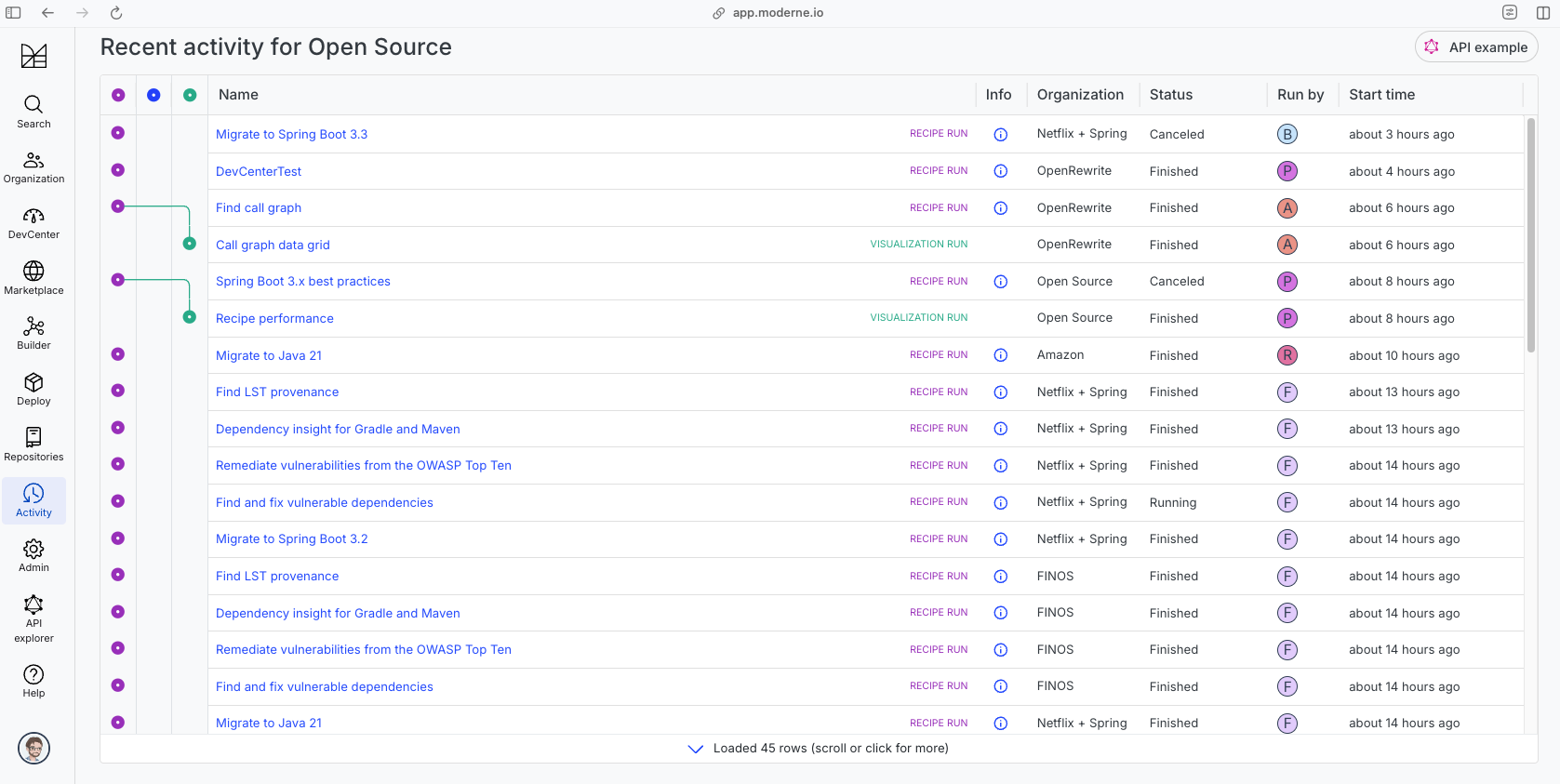
The community edition of the Moderne platform enables you to easily run recipes across thousands of open-source repositories.
Please contact Moderne for more information about safely running the recipes on your own codebase in a private SaaS.
Data Tables
- MavenMetadataFailures
- PowerMockTestsDisabled
- SourcesFileResults
- SearchResults
- SourcesFileErrors
- RecipeRunStats
Maven metadata failures
org.openrewrite.maven.table.MavenMetadataFailures
Attempts to resolve maven metadata that failed.
| Column Name | Description |
|---|---|
| Group id | The groupId of the artifact for which the metadata download failed. |
| Artifact id | The artifactId of the artifact for which the metadata download failed. |
| Version | The version of the artifact for which the metadata download failed. |
| Maven repository | The URL of the Maven repository that the metadata download failed on. |
| Snapshots | Does the repository support snapshots. |
| Releases | Does the repository support releases. |
| Failure | The reason the metadata download failed. |
PowerMock tests disabled for manual migration
org.openrewrite.java.testing.mockito.table.PowerMockTestsDisabled
Tests disabled because they use a PowerMock feature with no Mockito equivalent. Each row is an action item: rework the test so it does not reach into private members, then re-enable it.
| Column Name | Description |
|---|---|
| Source path | The path of the test source file. |
| Test class | The test class the disabled test belongs to. |
| Disabled element | The test method that was disabled, or the class name when the usage sits outside a test method and the whole class had to be disabled. |
| Scope | METHOD when a single test was disabled, CLASS when the whole test class was. |
| Reason | The PowerMock usage that cannot be migrated. |
Source files that had results
org.openrewrite.table.SourcesFileResults
Source files that were modified by the recipe run.
| Column Name | Description |
|---|---|
| Source path before the run | The source path of the file before the run. null when a source file was created during the run. |
| Source path after the run | A recipe may modify the source path. This is the path after the run. null when a source file was deleted during the run. |
| Parent of the recipe that made changes | In a hierarchical recipe, the parent of the recipe that made a change. Empty if this is the root of a hierarchy or if the recipe is not hierarchical at all. |
| Recipe that made changes | The specific recipe that made a change. |
| Estimated time saving | An estimated effort that a developer to fix manually instead of using this recipe, in unit of seconds. |
| Cycle | The recipe cycle in which the change was made. |
Source files that had search results
org.openrewrite.table.SearchResults
Search results that were found during the recipe run.
| Column Name | Description |
|---|---|
| Source path of search result before the run | The source path of the file with the search result markers present. |
| Source path of search result after run the run | A recipe may modify the source path. This is the path after the run. null when a source file was deleted during the run. |
| Result | The trimmed printed tree of the LST element that the marker is attached to. |
| Description | The content of the description of the marker. |
| Recipe that added the search marker | The specific recipe that added the Search marker. |
Source files that errored on a recipe
org.openrewrite.table.SourcesFileErrors
The details of all errors produced by a recipe run.
| Column Name | Description |
|---|---|
| Source path | The file that failed to parse. |
| Recipe that made changes | The specific recipe that made a change. |
| Stack trace | The stack trace of the failure. |
Recipe performance
org.openrewrite.table.RecipeRunStats
Statistics used in analyzing the performance of recipes.
| Column Name | Description |
|---|---|
| The recipe | The recipe whose stats are being measured both individually and cumulatively. |
| Source file count | The number of source files the recipe ran over. |
| Source file changed count | The number of source files which were changed in the recipe run. Includes files created, deleted, and edited. |
| Cumulative scanning time (ns) | The total time spent across the scanning phase of this recipe. |
| Max scanning time (ns) | The max time scanning any one source file. |
| Cumulative edit time (ns) | The total time spent across the editing phase of this recipe. |
| Max edit time (ns) | The max time editing any one source file. |